

Middle East Conflict: Procurement and Supply Chain Updates
Continuing conflict in the Middle East is affecting international shipping, energy markets, business travel and the availability and cost of some goods and services.
NWUPC is working with suppliers, UKUPC partners and relevant sector organisations to identify impacts affecting our Members. This page brings together the latest confirmed framework updates, wider procurement risks and practical actions for Members.
Conditions can change quickly. Information on this page is dated and should be considered alongside current supplier communications, contract terms and official government guidance.
Last reviewed: 3rd September 2026
If you are experiencing a significant supply interruption, new surcharge or other contract issue connected with the conflict, please contact Dave Yates, NWUPC’s Sustainable Relationships Manager.
NWUPC Updates for the Travel Group can be found on the NWUPC Discussion Board here.
NWUPC Updates for the Laboratories Group can be found on the NWUPC Discussion Board here
- On February 28th 2026, the U.S. initiated Operation Epic Fury with a joint attack on Iran alongside Israel.
- Shipping through the Strait of Hormuz and parts of the wider Gulf remains significantly disrupted and subject to operational restrictions.
- Red Sea and Suez Canal disruption continues to affect some shipping routes, lead times, insurance costs and freight charges.
- Energy and fuel markets remain sensitive to changes in regional supply and shipping conditions.
- Air travel and air freight may be affected by changing airspace restrictions, flight cancellations and reduced capacity.
- Products with potentially greater exposure include gases, laboratory supplies, electronics, semiconductors, AV equipment, chemicals and other goods dependent on petrochemical production or Gulf and Asian shipping routes.
- UK sanctions requirements continue to apply and should form part of supplier, payment and supply-chain due diligence.
- Members should confirm any proposed surcharge or contract change with the relevant NWUPC Category Manager before accepting it.
Members purchasing goods through NWUPC and UKUPC Frameworks are advised to:
- Confirm current lead times before agreeing delivery, installation or project dates.
- Ask suppliers whether goods, components or materials pass through affected ports or shipping routes.
- Identify time critical or business critical orders and discuss contingency arrangements with suppliers.
- Request written evidence explaining any proposed freight surcharge, price increase or contract change.
- Check whether a proposed additional charge is permitted under the relevant Framework and call-off contract.
- Contact the relevant NWUPC Category Manager before accepting a new surcharge or significant contract change.
- Notify NWUPC of serious or repeated disruption so that issues can be monitored across the wider membership.
Freight prices, routes and carrier surcharges can change at short notice. For this reason, fixed estimates of container surcharges have not been included on this page.
For current carrier information, visit Maersk’s operational news and advisories. Members should also refer to communications from their appointed supplier or logistics provider for information relating to individual orders.
Members using national energy Frameworks should continue to refer to TEC for current market information and guidance. Institution-specific questions about pricing, purchasing positions or budget exposure should be discussed directly with TEC (see the Energy dropdown further down this page).
For wider background information, see the International Energy Agency’s overview of the Strait of Hormuz.
TEC (The Energy Consortium)
Members using The Energy Consortium benefit from an established purchasing and risk-management approach, but should consult TEC for institution-specific budget exposure. https://www.tec.ac.uk/.
- Members can log into the TEC Portal to view live pricing indices and download custom budget risk reports.
- Key Global Metrics Tracked: Dashboards are closely monitoring the massive volatility in oil and gas caused by recent blockages and conflicts near critical corridors like the Strait of Hormuz and the Red Sea.
Oil and Natural Gas
Oil and natural gas markets remain sensitive to developments in the Middle East, particularly disruption affecting the Strait of Hormuz.
The Strait is a major international route for oil and liquefied natural gas exports. Changes to shipping activity, regional production or the availability of alternative routes can affect wholesale energy prices, fuel costs and wider supply-chain charges.
Market conditions can change quickly, and the effect on individual NWUPC Members will depend on their energy purchasing arrangements and the level of forward purchasing already undertaken.
BOC Fuel Surcharge – Important Update
We have been made aware that BOC recently issued a communication directly to some university end-users regarding the introduction of a fuel surcharge from 13 March. This communication was issued in error and should not have been sent ahead of formal approval and UKUPC member communication.
• The surcharge has now been suspended
• Any affected accounts will receive a full credit within 5 working days
We have addressed this directly with BOC to ensure this does not happen again.
Temporary Fuel Surcharge (From 16 April)
Following further discussions with BOC, a temporary fuel surcharge will be introduced from 16 April 2026:
• £3 – Cylinder and Cryospeed deliveries
• £22.50 – Bulk deliveries
This reflects current market pressures and has been agreed following detailed
review.
• The surcharge will be reviewed monthly
• First potential change: 1 May 2026 (aligned for the HE sector)
• Members will receive advance notice of any changes
Please note: There is no profit element included in the fuel or helium surcharges.
Helium Surcharge BOC
Given the escalating military situation in the Middle East around the Straits of Hormuz, we have been informed by BOC of a requirement to implement a temporary operational surcharge on Helium with immediate effect from today, March 10th. Attached is a copy of the letter being distributed to end-user customers today which provides further geopolitical context and how the suspension of operations at Qatari oil-refineries is unfortunately affecting the supply of Helium which is a by-product of Liquid Natural Gas production.
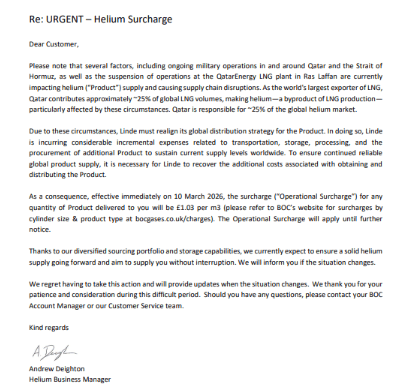
I can confirm the surcharge for any quantity of product delivered is £1.03 per m3 (please refer to BOC’s website for surcharges by cylinder size & product type at bocgases.co.uk/charges) and is applicable until further notice. BOC are keen to emphasise that currently there are no plans to enter an allocation event and that there are stocks available, with the surcharge being applied to recover their additional costs incurred from supply chain disruptions, with no additional profit being made.
Please be assured that UKUPC will be working closely with BOC to update the sector with any changes that may occur given this is a constantly moving picture.
Continuing disruption in the Middle East may affect some technology and electronics supply chains. Potentially exposed products include semiconductors, batteries, computing equipment, audiovisual products and specialist electronic components.
Impacts will vary depending on where products and components are manufactured, the shipping routes used and the availability of alternative stock. Members should treat these as categories to monitor rather than assume that shortages or delays will affect every supplier.
Members planning technology purchases, equipment installations or major projects are advised to:
- Confirm product availability and expected lead times before placing an order.
- Avoid committing to installation, launch or project dates until delivery times have been confirmed.
- Ask suppliers whether key components or shipping routes are exposed to disruption.
- Discuss suitable alternatives where the specified product has a lengthy or uncertain lead time.
- Identify orders that are business-critical or linked to fixed academic, construction or operational deadlines.
- Request a written explanation for any proposed surcharge, price increase or change to an agreed delivery date.
- Contact the relevant NWUPC Category Manager if a significant supply issue affects a Framework purchase.
Members should continue to work through their appointed suppliers and refer to current supplier communications for order-specific information.
Conflict and changing security conditions in the Middle East may affect passenger travel and air-freight services. Disruption can extend beyond the region when airlines alter routes in response to airspace restrictions, airport closures or security concerns.
Possible impacts include:
- Flight cancellations or schedule changes
- Longer journeys caused by aircraft rerouting
- Reduced passenger and freight capacity
- Changes to connections and transit arrangements
- Increased fares or air-freight charges
- Delays to time-sensitive or high-value deliveries
Business travel
Members arranging business travel should:
- Check current Foreign, Commonwealth & Development Office advice for every destination and transit country.
- Consult their appointed travel management provider before booking or changing travel.
- Confirm airline schedules and airport arrangements shortly before departure.
- Review institutional travel approval, insurance and traveller-safety requirements.
- Avoid making non-refundable arrangements where the journey remains uncertain.
- Ensure travellers have appropriate emergency and out-of-hours contact details.
See the Government’s foreign travel advice by country for the latest official information.
Air freight
Members expecting time-sensitive goods by air should confirm current delivery arrangements with the supplier or freight provider. Particular attention may be required for pharmaceuticals, laboratory products, electronics, specialist components and other high-value or operationally critical goods.
Any proposed air-freight surcharge, alternative delivery method or significant change to agreed terms should be provided in writing. For purchases through an NWUPC or UKUPC Framework, Members should contact the relevant NWUPC Category Manager if assistance is required.
Continuing disruption across the Middle East is affecting some international shipping routes, ports and freight services. Restrictions in and around the Strait of Hormuz, alongside continuing disruption affecting the Red Sea and Suez Canal, may result in vessels being rerouted or services being temporarily changed.
Where alternative routes are used, Members may experience:
- Longer and less predictable delivery times
- Changes to shipping routes or ports
- Reduced freight capacity
- Increased fuel, insurance and transportation costs
- Additional carrier or supplier surcharges
- Delays affecting goods manufactured in or transported through the Middle East and Asia
The extent of any disruption will depend on the supplier, product, country of origin and transportation route. Members should avoid assuming that all products or contracts will be affected in the same way.
Continuing disruption in the Middle East may affect some construction and industrial supply chains through changes to energy prices, shipping routes, freight capacity and transport costs.
Potentially exposed products and materials may include:
- Steel and aluminium
- Cement and related building materials
- Chemicals and industrial gases
- Plastics, insulation and other petrochemical-derived products
- Mechanical and electrical components
- Imported fixtures, fittings and specialist equipment
The level of exposure will vary between products and suppliers. Members should not assume that all construction projects, suppliers or materials will be affected.
Members managing construction, refurbishment or estates projects are advised to:
- Confirm product availability and lead times at an early stage.
- Ask suppliers to identify materials with potentially disrupted supply routes.
- Review the effect of delays on project programmes and dependent works.
- Consider technically suitable alternatives where particular materials are unavailable.
- Request written evidence supporting any proposed surcharge, price increase or change to delivery terms.
- Check the relevant Framework, call-off contract and agreed price-adjustment provisions before accepting additional costs.
- Contact the relevant NWUPC Category Manager if a significant issue affects a Framework purchase.
Members should maintain open communication with contractors and suppliers, particularly where materials are required for time-sensitive, safety-critical or business-critical works.
UK sanctions relating to Iran may affect procurement activity involving particular individuals, organisations, goods, technology, ships and financial transactions.
Members should continue to apply proportionate due diligence when purchasing goods or services with a potential connection to Iran or other sanctioned parties. This may include checking:
- The identity and beneficial ownership of suppliers, subcontractors and intermediaries
- Whether an organisation or individual appears on the UK Sanctions List
- Banking arrangements, payment routes and the financial institutions involved
- Shipping companies, vessels, ports and countries of transit
- The origin, destination and intended end use of goods or technology
- Whether products include restricted goods, components or technology
- Whether a proposed transaction requires a licence or other authorisation
Sanctions may apply even where Iran is not the immediate supplier or destination. Members should therefore consider the wider supply chain, including intermediaries and the ultimate destination or end use of relevant goods and technology.
For current requirements, refer to the Government’s Iran sanctions guidance and the UK Sanctions List.
If a potential sanctions issue is identified, Members should pause the transaction and seek advice from their institution’s legal, compliance or finance team before proceeding. NWUPC can assist with questions relating to the relevant Framework, but cannot provide legal advice on an individual transaction.